Industry Insights: Distillation Equipment for Converting Used Lubricating Oil to Diesel Fuel
The recycling of used lubricating oil (ULO), also known as waste or spent engine oil, into valuable diesel fuel represents a critical intersection of environmental stewardship and resource recovery. Specialized distillation equipment lies at the heart of this transformation, enabling a process that diverts hazardous waste from landfills and waterways while producing a usable fuel product. This article delves into the industry knowledge surrounding used car oil refinery plants, the refining process, and the core technology-the oil recycling to diesel machine.
1. The Problem and the Opportunity: Used Lubricating Oil
Used engine oil is a complex and contaminated substance. During its service life, it accumulates metallic wear particles (from engines), soot, water, fuel dilution, acidic by-products, and additive breakdown compounds. Simply dumping or improperly disposing of it poses severe environmental risks. However, within this waste stream lies significant potential. The base of most lubricating oils is refined petroleum hydrocarbons, which can be reclaimed and reconstituted through careful processing.
The primary product of this recycling is a distillate fuel, often termed "recycled diesel oil" or "fuel oil." It is crucial to understand that while this product can be used in industrial burners, boilers, or certain diesel engines (often after blending or further treatment), its properties may differ from standardized automotive diesel (EN 590 or ASTM D975) and must be evaluated against local fuel specifications and regulations.
2. Core Technology: The Distillation Process
The conversion of ULO to diesel is fundamentally a Chemical separation process based on boiling points, achieved through distillation. The basic principle involves heating the waste oil in a controlled environment to vaporize the lighter hydrocarbon fractions, which are then condensed back into liquid fuel. The process typically involves several key stages to ensure safety, efficiency, and product quality.
Pre-treatment: This is a vital first step. Feedstock (ULO) is often passed through a filtration system to remove coarse solids and particulate matter. Dehydration is also critical, as water in the oil can cause dangerous pressure surges during heating (steam explosion risk) and hinder the process. Simple settling tanks or preliminary heating can remove bulk water.
Thermal Distillation (Atmospheric or Vacuum): The pre-treated oil is fed into a reactor or still. It is heated indirectly, usually by a thermal oil heater, natural gas, diesel or electric heater, to avoid direct flame contact which can cause coking.
Atmospheric Distillation: Operates at ambient pressure. Lower temperatures vaporize lighter fuels (like a gasoline fraction), followed by the target diesel-range hydrocarbons at higher temperatures. The challenge is that excessive heat (above ~360°C) at atmospheric pressure can crack heavier molecules, producing non-condensable gases and accelerating the formation of coke, a solid carbonaceous residue.
Fractional Condensation: The vapors travel from the distillation reactor into a fractionating column or a series of condensers. Here, careful temperature control allows for the separation of different "cuts." Lighter fractions condense in cooler condensers, while the diesel-range fraction condenses in a subsequent stage. This separation is key to producing a fuel with a consistent boiling range and flash point.
Post-Treatment and Polishing: The raw distilled diesel is often dark and may contain residual acids and impurities. A crucial post-treatment step is clay polishing or acid-clay treatment. The hot liquid fuel is passed through a tower or mixer containing activated bleaching clay (or sometimes a mild acid wash followed by clay). The clay absorbs polar compounds, residual additives, colored bodies, and odorous elements, significantly improving the fuel's color (to a light yellow or straw), stability, and cleanliness. Finally, the product is filtered to remove any fine clay particles.
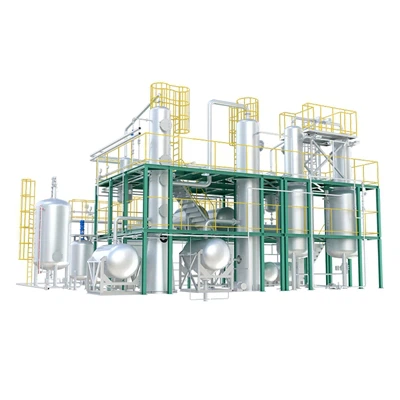
3. Key Components of an "Oil Recycling to Diesel Machine" (The Plant)
A complete system is more than just a still. A standard setup includes:
Feedstock Pre-treatment Unit: Including filters and dehydration tanks.
Feeding System: Pumps to move oil into the reactor.
Reactor / Distillation Kettle: The heated vessel where vaporization occurs, often with agitation to prevent local overheating.
Heating System: An external, indirect heating source (thermal oil heater is common for its safety and even heat).
Fractionating Column & Condenser System: For separating and liquefying vapors.
Vacuum System (for advanced models): Pumps and seals to create and maintain reduced pressure.
Post-treatment System: Clay polishing tower and associated filters.
Emissions Control System: This is critical for environmental compliance. Non-condensable gases from the process must be routed through a scrubbing system or, preferably, fed back into the heating system as fuel to be safely combusted, preventing air pollution.
Control Panel: For monitoring temperature, pressure, and vacuum.
4. Industry Considerations and Challenges
Feedstock Quality: Consistency of the ULO feedstock affects operation. High levels of water, glycol (antifreeze), or chlorinated solvents pose significant processing and safety challenges.
Safety Paramount: The process involves high temperatures, hot oils, and potentially flammable vapors. Equipment must have robust safety features: pressure relief valves, temperature controls, flame arrestors, and inert gas blanketing systems.
Environmental Compliance: A legitimate operation must account for all outputs: the liquid fuel product, solid residue (coke and spent clay), and emissions. Proper disposal or utilization of these wastes is mandatory. On-site combustion of gases and use of coke as solid fuel can reduce waste streams.
Product Quality and Market: The final fuel's cetane number, sulfur content, and cold properties may vary. Its suitability as a direct substitute for standard diesel depends on the refining depth. Many operators successfully market it to industrial users for furnace fuel. Further hydrotreating (a more complex chemical process) would be required to make automotive-grade diesel.
Technology Scale: Equipment ranges from small batch systems (e.g., 10 tons per day) to large continuous plants. Batch systems are more common for small to medium enterprises.
Conclusion
Distillation equipment for converting used engine oil to diesel fuel provides a tangible solution for managing a persistent waste stream. The technology, centered on controlled thermal separation and polishing, is well-established but requires careful operation and a strong commitment to safety and environmental management. As raw material costs and environmental regulations intensify, efficient and compliant oil recycling to diesel machines offer a sustainable pathway for recovering energy from what was once considered a troublesome waste. Potential investors or operators must thoroughly evaluate the technology provider's expertise, the system's safety features, and the local regulatory landscape for both the recycling process and the fuel product market.